
AI clipselection
AI clip selection: why each clip was chosen
Most AI clippers hand back as many clips as they can. Snipri, an AI clip maker for podcasts and long videos, scores every candidate, drops the weak ones and shows you the scores, so you spend your time posting clips rather than sorting them.
Your first 2 videos are free, up to 1 hour each. No credit card required.
What is AI clip selection?
AI clip selection is how an AI clip maker decides which moments of a long video become clips. Snipri gives every candidate 5 scores from the transcript and keeps only those whose hook, payoff and standalone sense reach 7 out of 10, then reframes each to 9:16, captions it and says why it was kept.
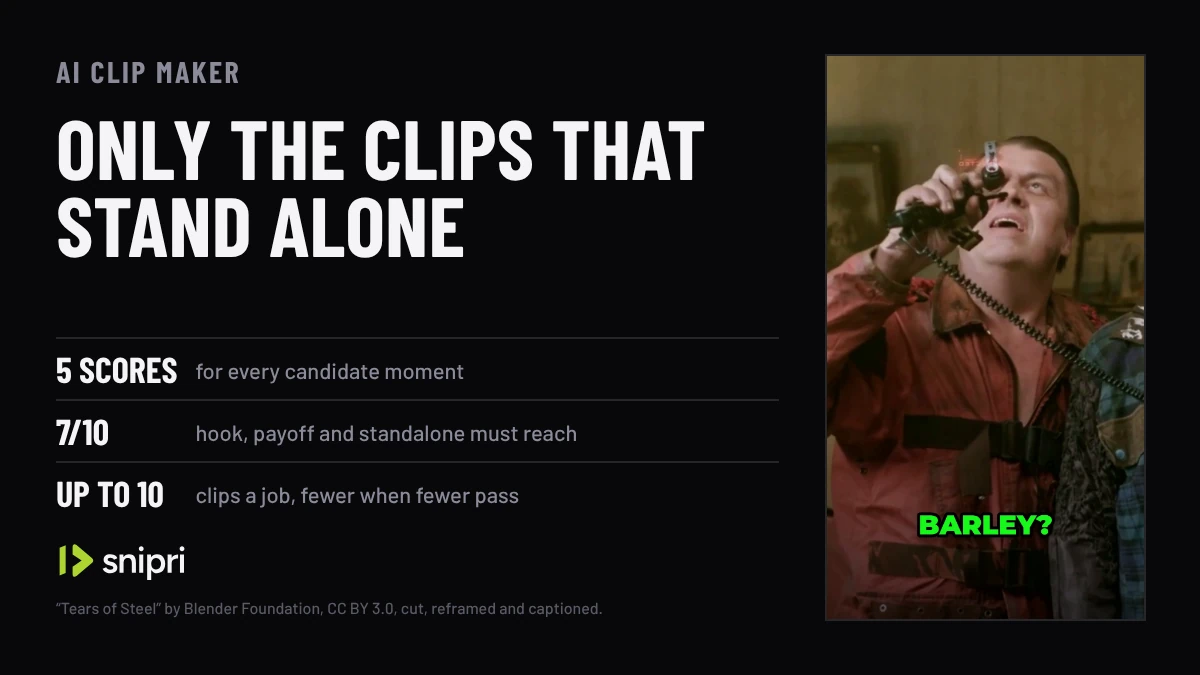
5 scores
Hook, Payoff, Standalone sense, Arc and Quotability
7/10
The bar hook, payoff and standalone sense must each reach
Up to 10
Clips from each job, fewer when fewer moments pass
16 kinds
Of video, each judged by its own rules, or Auto
300 characters
To name the moments you want it to look for
15 to 60s
Clip length by default, or choose 10 to 30s, 30 to 60s, 60 to 90s or 90s to 3 min
How Snipri picks each clip
Say what you want, or leave it on Auto
Before a job you can pick the kind of video, the clip length and up to 300 characters of moments to look for. On Auto, Snipri names the kind of video from the transcript.
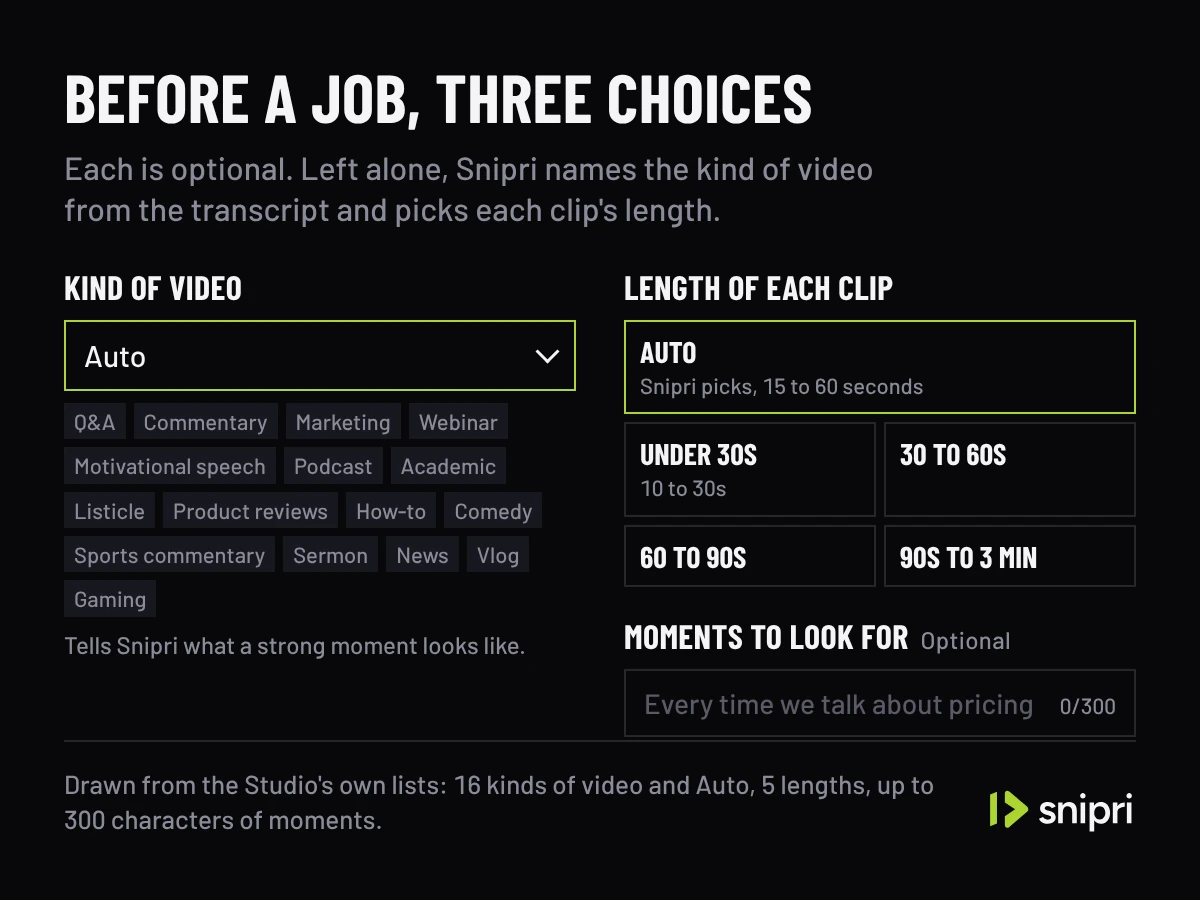
The choices before a job, drawn from the Studio's own lists. Every candidate gets five scores
Hook, payoff and standalone sense must each reach 7 out of 10. Moments that pass are ranked by hook and payoff, with standalone sense, arc and quotability breaking ties.
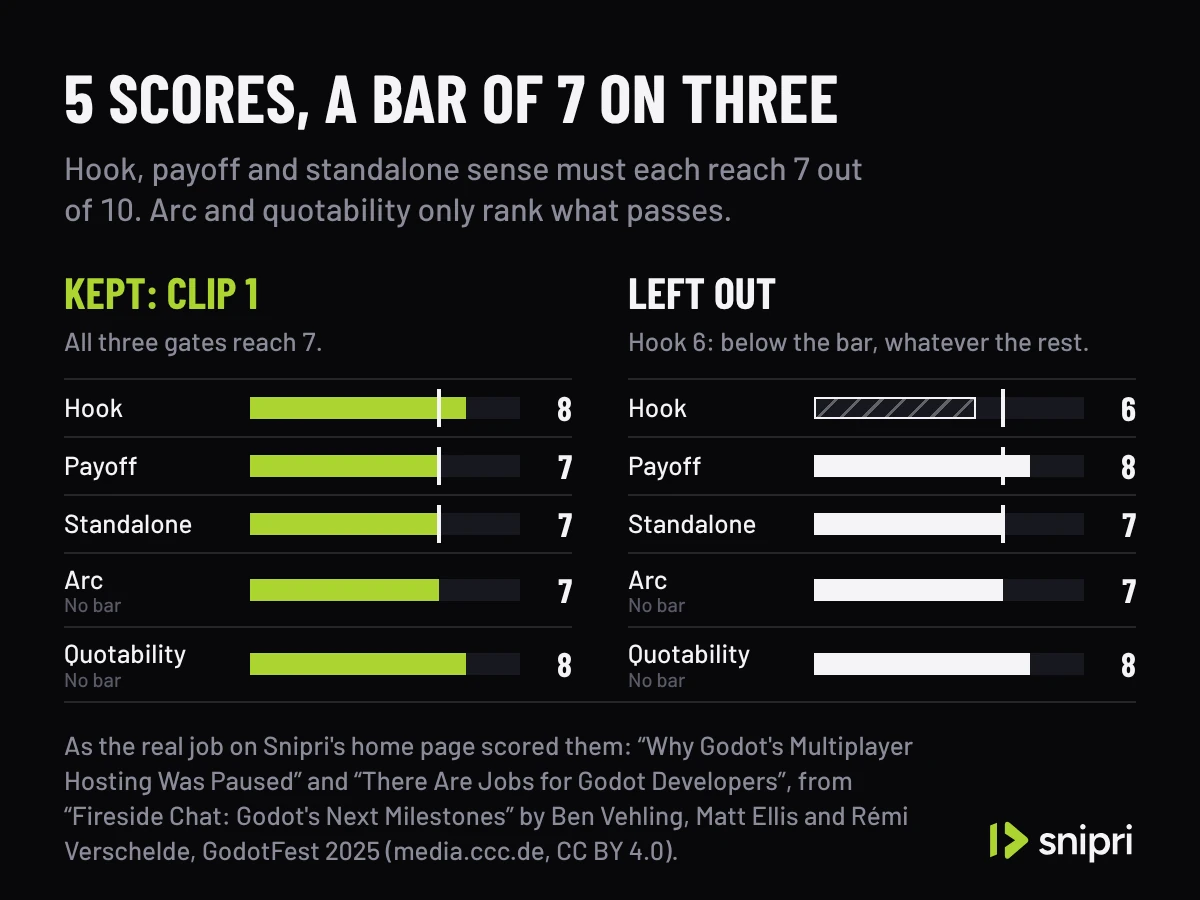
Two moments of the job on the home page, a clip and a moment it left out, against the bar the worker applies. Only the moments that pass are cut
A job returns up to 10 clips, and fewer when fewer moments pass. Each comes with its scores and a written reason, under Why this clip in My clips.
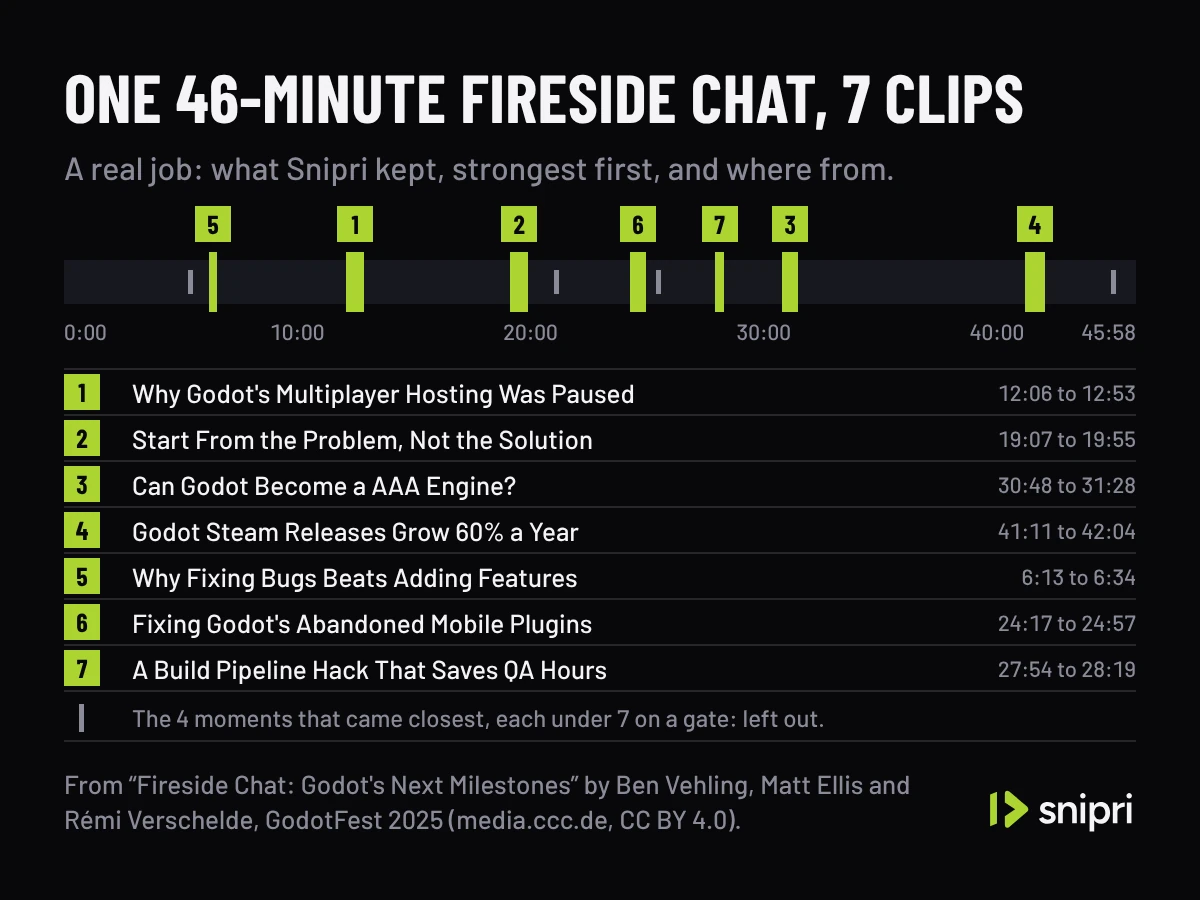
One real job from the home page: what was kept from a fireside chat, and where.
One real job
One of the clips it kept.
Cut from 41:11 of a 46-minute fireside chat, one of the 7 moments Snipri kept from it, with the captions the job gave it.
On podcasts, webinars and interviews
Podcast clip maker
On Podcast it keeps the question when the answer needs it and leaves out intros, sponsor reads and “before we start” housekeeping.
Webinar clip maker
On Webinar it keeps a framework with its example and leaves out agendas, housekeeping, logistics, and recording or slide notices.
Interview clip maker
An answer becomes a clip only when it carries enough context to stand alone, so you get whole answers rather than fragments.
What AI clip selection does not do
It does not predict views.
The scores say why a moment works on its own, and there is no virality percentage.
It does not pad a job.
A recording with two strong moments gives two clips, and one with none does not count as a video.
It reads what is said.
A moment carried by the picture alone, with nothing said about it, is not one it can find.
It does not post for you.
You download the clips and post them yourself.
Frequently asked questions
What does the AI look at?
The transcript, with word-level timings. It looks for complete spoken thoughts with a strong opening, a clear payoff and enough context to make sense alone. You can also tell it the kind of video, how long each clip should run and the moments to look for; a moment you ask for still has to stand on its own to be kept.
Does it predict how many views a clip will get?
No. Each clip comes with its five scores and a written reason for keeping it, which say why the moment works on its own. There is no virality percentage, because nothing in a transcript can promise views.
Do I need editing experience?
No. Clips arrive captioned and framed. The editor is there if you want to change something.
How do I pay?
By the video, not by the clip: a recording counts as one video for each hour of it, rounded up, whether it gives you three clips or ten, and editing, re-rendering or splitting a clip afterwards is free.
Is Snipri free?
You start with 2 free videos of up to 1 hour each, once, with a watermark and no credit card. Paid plans start at $29.90/month for 10 videos a month, each up to 2 hours, without a watermark. A video counts once for each hour of it, rounded up, and only when it gives you at least one clip.
More Snipri features
Auto reframe
Auto reframe turns horizontal video into vertical 9:16 clips. Snipri finds the speaker in each shot, stacks two or three people, or keeps the whole shot.
Animated captions
Animated AI captions for vertical clips: every word timed to the moment it is said, in a style you pick, in 25 languages, and restyled any time after export.
Brand kit
Save your logo, handle, font and caption look once in Snipri's brand kit, and every new clip is born wearing them. Change the kit any time, on every plan, free.
Clip editor
Snipri's clip editor: trim, split or extend a clip, rewrite its hook title, restyle the captions, add text, images, B-roll and music, then re-render it free.
Guides and comparisons
Try it on your own recording.
Upload one recording and see AI clip selection on your own video. Your first 2 videos are free, up to 1 hour each, no credit card needed.