Short answer. Hook ideas for a clip are already in your recording: a sharp question, a claim, a surprising fact, a verdict or the first line of a story, said in the clip's first seconds. Snipri looks for a different opening in each kind of video and scores the spoken opening from 1 to 10; a moment becomes a clip only at 7 or more. A title card can sit over that line, but cannot rescue a weak one.
- A hook is a clip's opening. TikTok's guide for small businesses says to hook viewers in the first three seconds, its ad guidance says the first six, and YouTube's Shorts guide says the first few.
- The hook is found, not written: a question, a claim, a fact, a verdict, a problem or the first line of a story that someone in the recording already said.
- Snipri's selection looks for a different opening in each kind of video, from a sharp question in a Q&A to the headline fact in news.
- Snipri scores a moment's spoken opening from 1 to 10 and makes it a clip only when hook, payoff and standalone sense each reach 7.
- In five real jobs on conference talks, 15 of the 20 moments that came closest to being clips fell short on the hook, and each of them scored 6.
- A weak opening leans on a sentence the viewer never heard. Fix where the clip starts; a title card cannot rescue the line under it.
A hook is the first thing a clip says, and a recording you already made is full of them. What the platforms say about hooks below comes from TikTok's, YouTube's and Instagram's own pages, read on November 12, 2026. What Snipri looks for comes from its code, and the examples from five real jobs it ran on conference talks.
What counts as a hook?
A hook is a video's opening: what is said and shown in its first seconds, before a viewer decides to stay or scroll. The platforms' own pages agree on that much and differ on the window:
| Page | What it says about the opening | Where it comes from |
|---|---|---|
| TikTok, performance ads | Put the hook in the first 6 seconds, and what you offer in the first 3 | TikTok's creative best practices |
| TikTok, small businesses | Catch viewers within the first three seconds, lead with the value, and leave out long intros and logo animations | TikTok's video advertising guide |
| YouTube Shorts | Win attention in the first few seconds, before a viewer scrolls on, with no number given | YouTube's guide to getting started with Shorts |
| YouTube, long videos | Win viewers in the first 5 to 10 seconds so that they keep watching | YouTube for Creators |
| Instagram Reels | Surprise people with a reveal, a punchline or a twist, with no number of seconds | Instagram for Creators |
None of these pages says how many views a hook earns, and neither does this post. What YouTube's search and discovery tips do name are two signals its ranking reads: how long people watch a video on average, and what share of it they watch. A viewer who leaves in the first seconds lowers both.
Snipri scores the hook as its own number. Its selection rates how hard a moment's first 3 seconds or so grab attention, from 1 to 10, and a moment becomes a clip only when its hook, its payoff and its standalone sense each reach 7. The AI clip maker page shows those scores on real clips.
What kinds of hook does a recording already hold?
The same few: a question, a claim, a fact, a verdict, a problem and the first line of a story. None of them has to be written, because someone in the recording already said it.
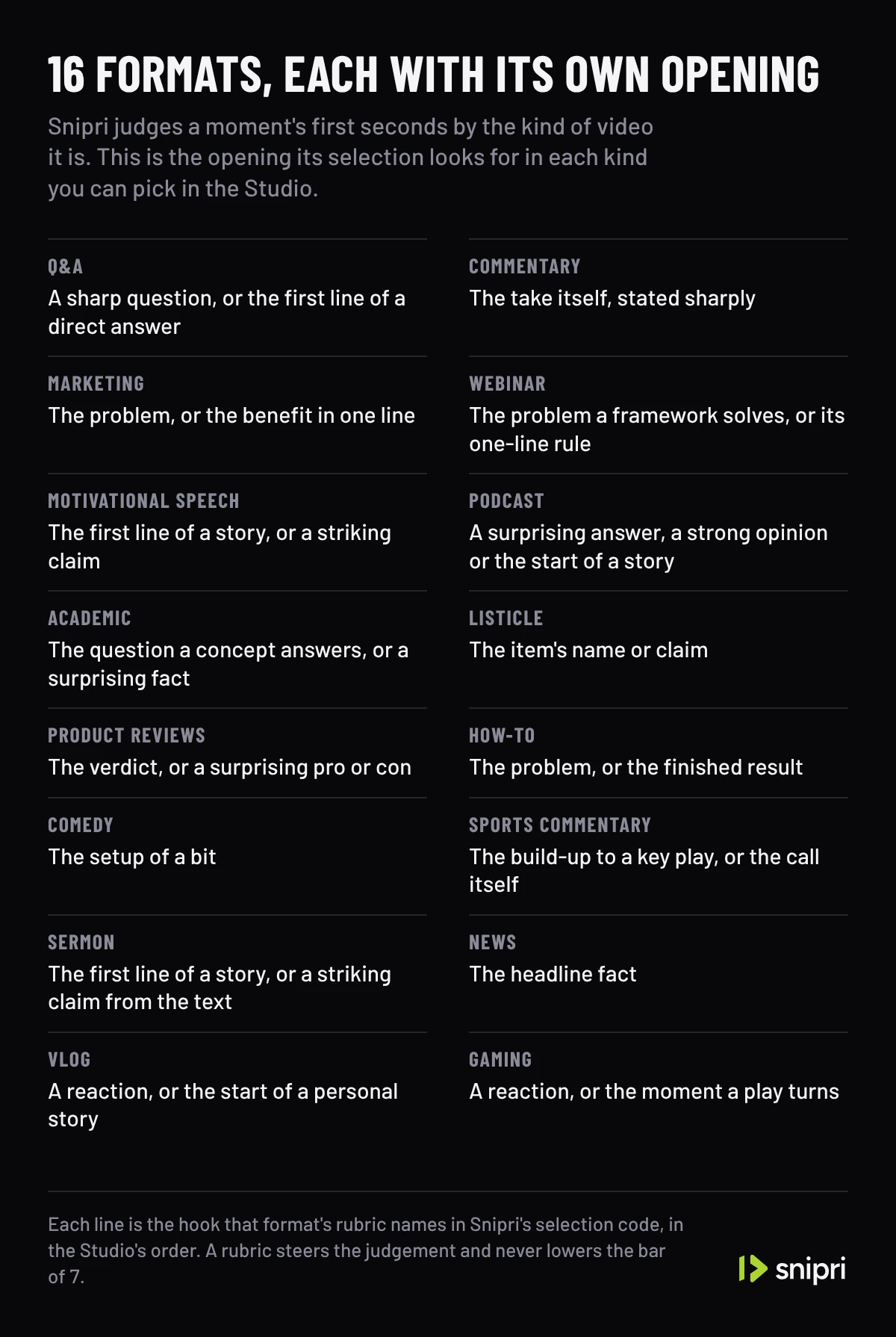
Snipri keeps a rubric for each kind of video you can pick in the Studio, and every rubric names the opening to look for. Sorted by the kind of opening, they come to this:
| Kind of opening | What to listen for | Where it comes from |
|---|---|---|
| A question | A sharp question, or the question a concept answers | The rubrics for Q&A and Academic |
| An answer | The first line of a direct answer, or a surprising answer | Q&A and Podcast |
| A take or a verdict | The take itself, a strong opinion, the verdict | Commentary, Podcast and Product reviews |
| A claim | A striking claim, or the claim a list item makes | Motivational speech, Sermon and Listicle |
| A fact | The headline fact, or a surprising one | News and Academic |
| A problem or its fix | The problem, the benefit in one line, a one-line rule, the finished result | Marketing, Webinar and How-to |
| A story's first line | The first line of a story, or the start of a personal one | Motivational speech, Sermon, Podcast and Vlog |
| A setup or a reaction | The setup of a bit, the build-up to a key play, a reaction | Comedy, Sports commentary, Vlog and Gaming |
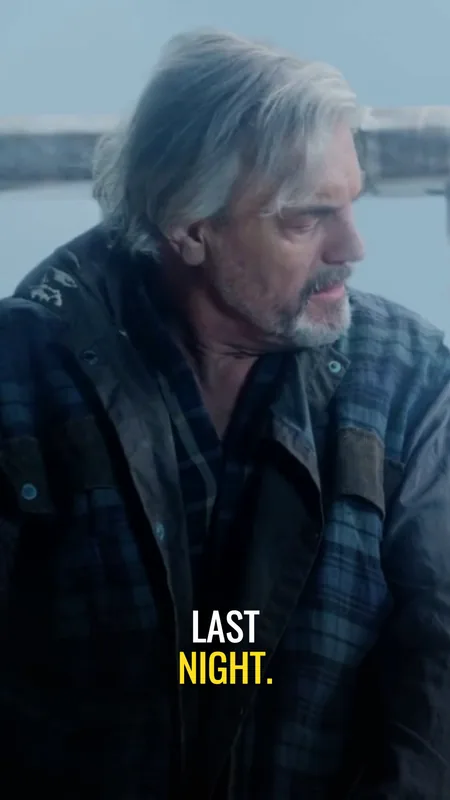
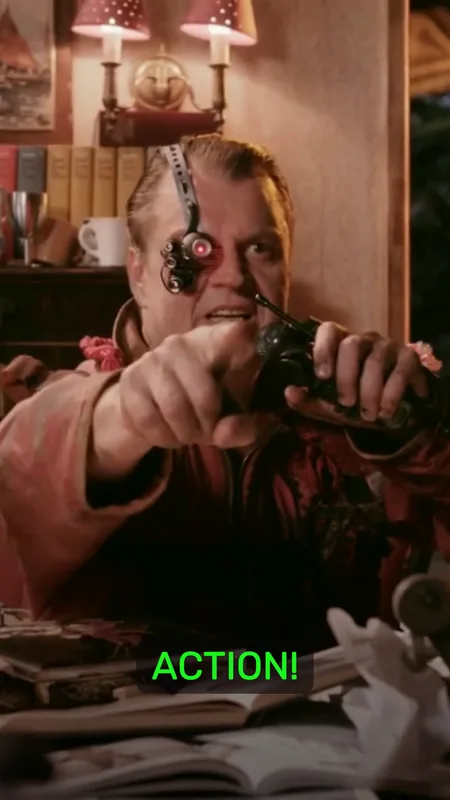
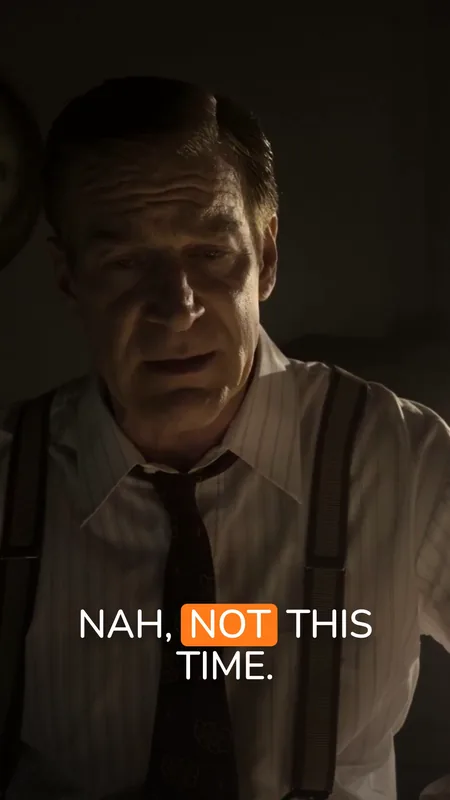
Four of those kinds are easier to hear than to read. In the video, each is a line from a film, played as a vertical clip beside the two formats whose rubric names it:
Four lines from the film Meridian play as vertical clips Snipri reframed, with the film's own caption text burned in by Snipri's renderer: a question, a story's first line, a claim and a fact. Each line plays and then holds on its last caption. Beside each clip, the line and the two formats whose rubric names that kind of opening are drawn. The kinds are our names for the lines, and the lines were cut for this example: Snipri did not choose them.
Film: “Meridian” by Netflix, from Netflix Open Content, under CC BY 4.0, cut, reframed and captioned, without sound.
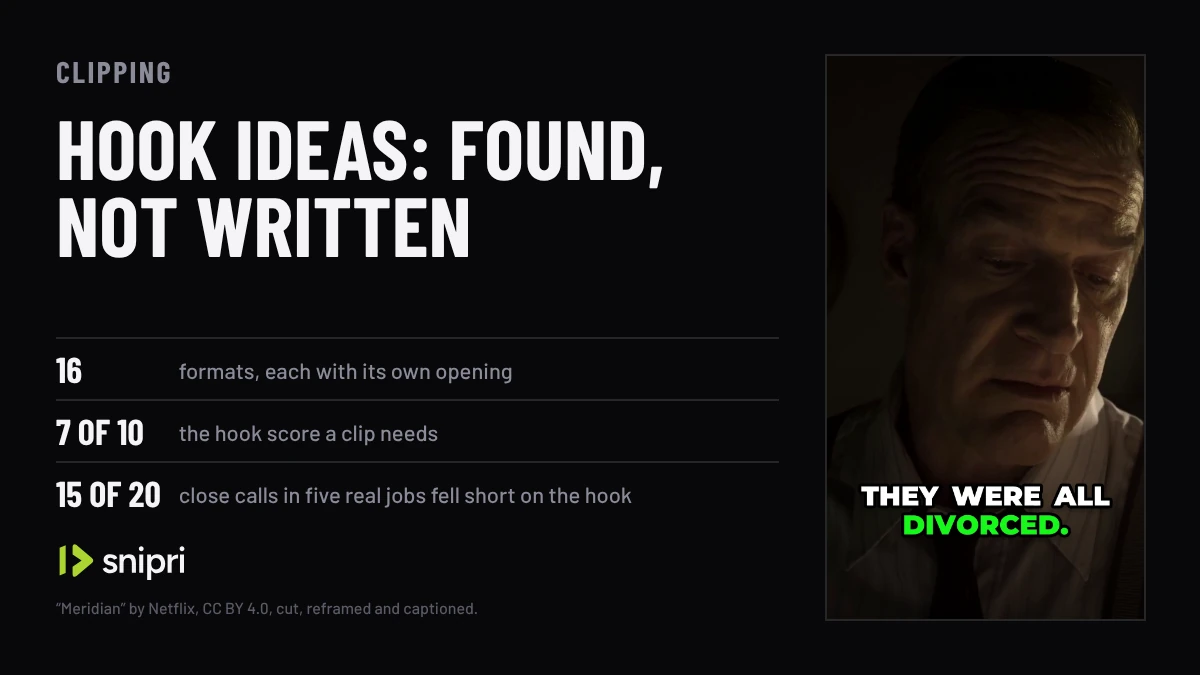
The lines are a film's, cut for the example. Lifted out of their scene, two of them also show the problem the next sections are about: "They were all divorced" never says who they are, and "He said he was walking his dog" leaves "he" to the scene before. The kind of opening is right, and the clip would still have to start earlier.
What do found hooks look like in real recordings?
Like ordinary sentences that happen to open well. On 2 and 3 November 2026 Snipri ran on five conference talks and kept 41 clips, each stored with its scores and a reason in a sentence (the whole count adds the five jobs up). Many of the reasons name the opening:
| Clip, by the title Snipri wrote | Hook score | What the reason says about the opening | Where it comes from |
|---|---|---|---|
| Why Anti-Stalking Alerts Assume Good Faith | 7 | “It opens on a pointed question and then gives the twist” | Find My * 101 |
| AI's Best Trick Is Changing Humans | 8 | “A counterintuitive claim is stated at the start” | Frank talks AI, keynote style |
| Booting a Virus From an 800-Byte File | 8 | “Gives a concrete size, then the result” | Reverse Engineering Life |
| Can Godot Become a AAA Engine? | 8 | “A direct, contrarian opinion with reasoning” | Fireside Chat: Godot’s Next Milestones |
| Rotate Broadcast Keys to Stop Tracking | 7 | “It opens on a one-line rule that exposes the flaw” | Find My * 101 |
| His Cure for Paranoia: Techno Festivals | 8 | “A relatable question gets a short, unexpected answer” | Ask me anything, with Huib Modderkolk |
A question, a claim, a fact, a take, a rule and an answer, and nobody wrote any of them after the talk. No clip in the five jobs scored above 8 on its hook: the scale keeps 9 and 10 for the exceptional.
The talks are published under CC BY 4.0 on media.ccc.de: “Fireside Chat: Godot’s Next Milestones” by Ben Vehling, Matt Ellis and Rémi Verschelde, GodotFest 2025; “Find My * 101” by Henryk Plötz, 38C3; “Ask me anything, with Huib Modderkolk” by Chris van 't Hof and Huib Modderkolk, Hacker Hotel 2025; “Frank talks AI, keynote style” by Frank Breedijk, Hacker Hotel 2025; and “Reverse Engineering Life: A teardown of the DNA source code of a whole bacterium” by bert hubert, WHY2025. The scores, titles and reasons are Snipri's. The speakers and the conferences have no connection to Snipri.
What does a weak opening sound like?
It leans on something the viewer never heard. Each of those five jobs also stored the four moments that came closest to being clips, and 15 of those 20 close calls scored under 7 on the hook, more than fell short on either other gate. That is what happened in five jobs, not a rate.
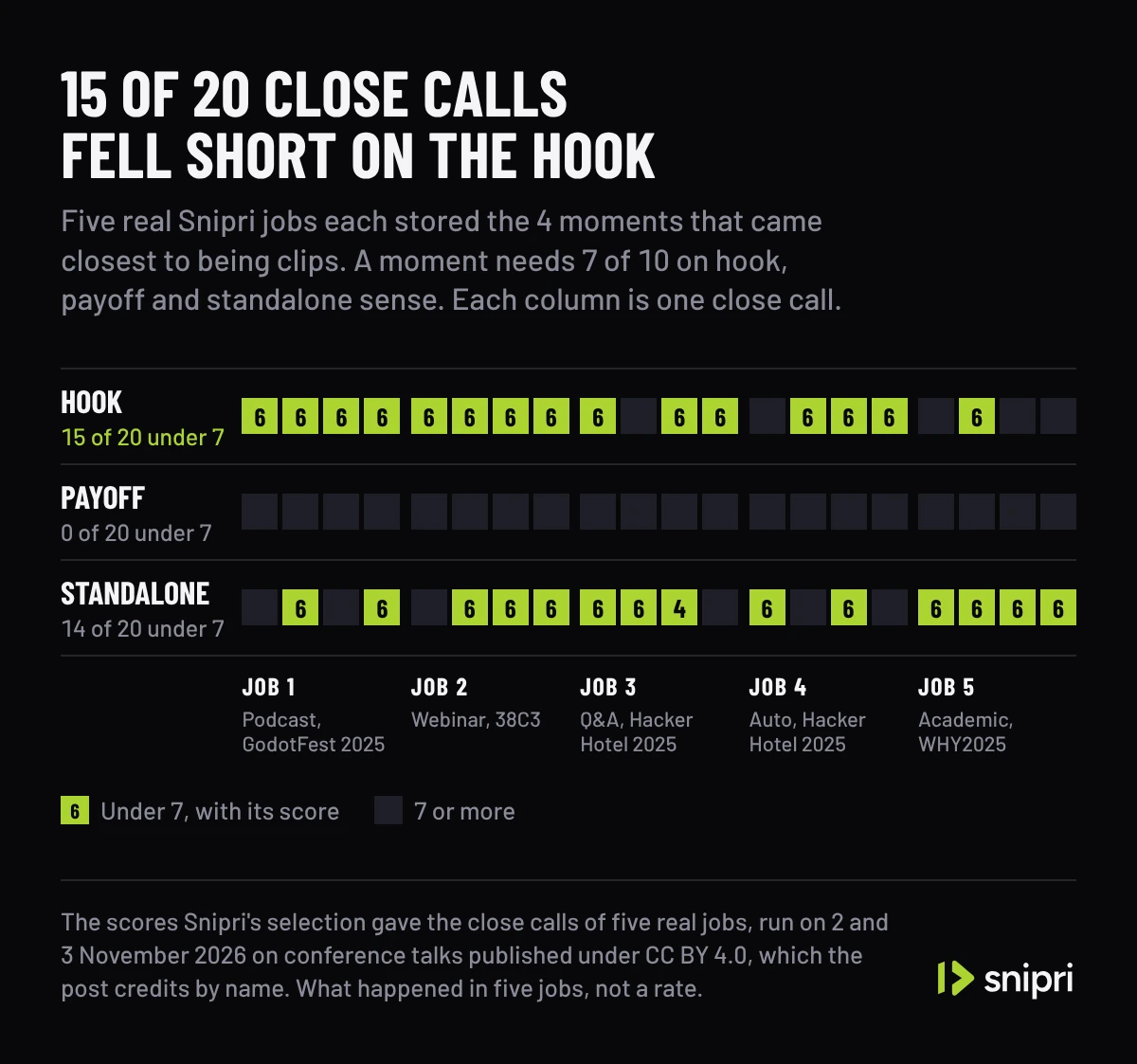
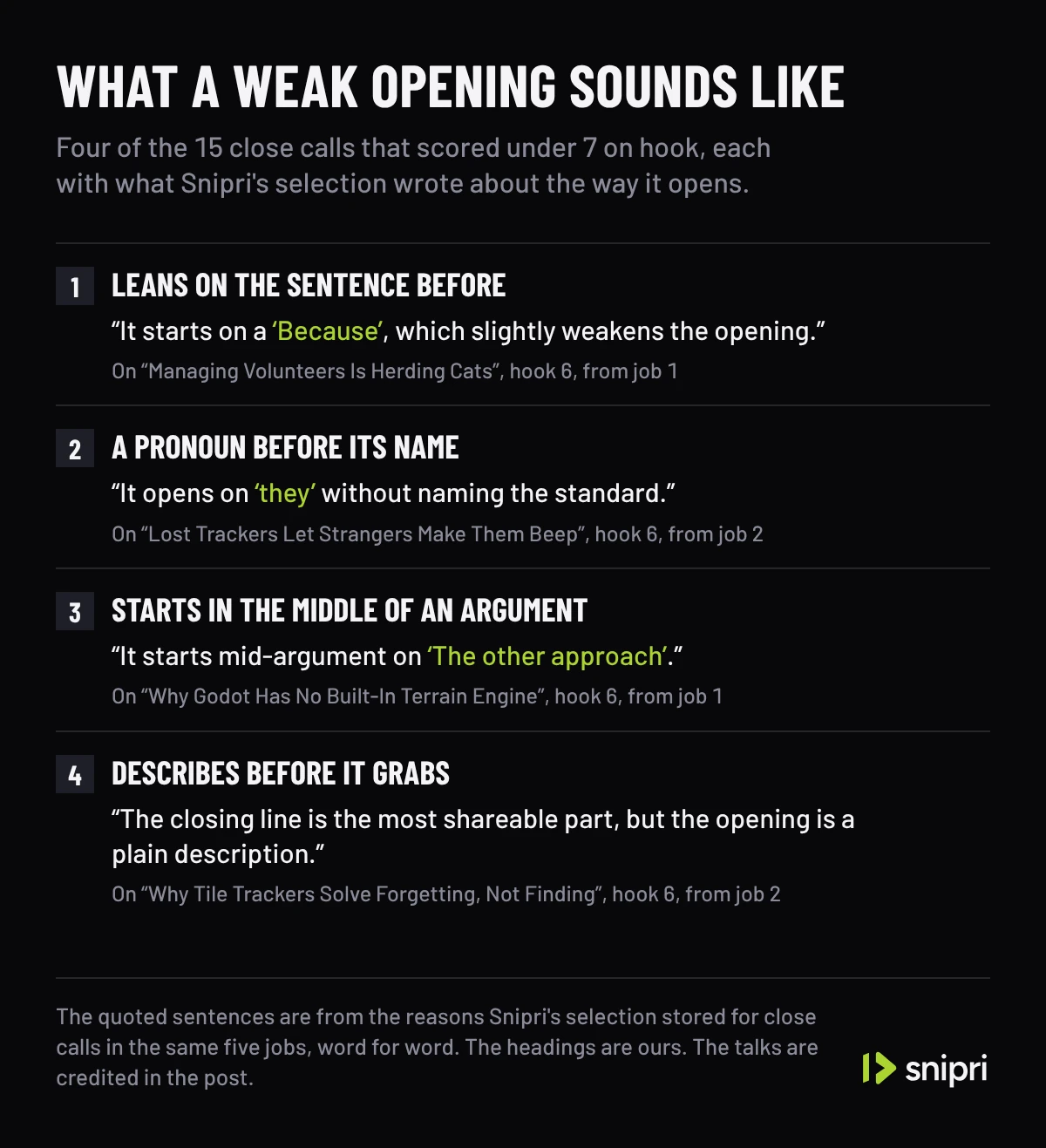
The reasons stored with those close calls say how the openings went wrong, and the same faults repeat:
- It leans on the sentence before. One started on "Because".
- A pronoun comes before its name. One opened on "they" without naming what the word stood for.
- It starts in the middle of an argument. One began at "The other approach".
- It describes before it grabs. One kept its strongest line for the end.
Most of them are fixed by where the clip starts, not by new words. Snipri's selection is told to choose the cut that makes a moment work before it scores it: start earlier to take in the setup, or later so the clip opens on its hook. You can do the same in the editor, where the Trim panel moves a clip's start a sentence at a time, earlier too where the clip has footage to spare. Trim and split a clip covers it.
Can a written hook replace a spoken one?
No. A title card is text over the opening. It tells a viewer what the clip is about, and it changes nothing about what the first line says.
Snipri writes a title for each clip it chooses and, with Hook title on, shows it as a card over the clip's first seconds. In the editor you can retype the card under Hook and set how long it stays. The line under it is still the one the hook score judged, and the instructions Snipri's selection works to rule the shortcut out: an invented title cannot rescue an opening that is weak or depends on context.
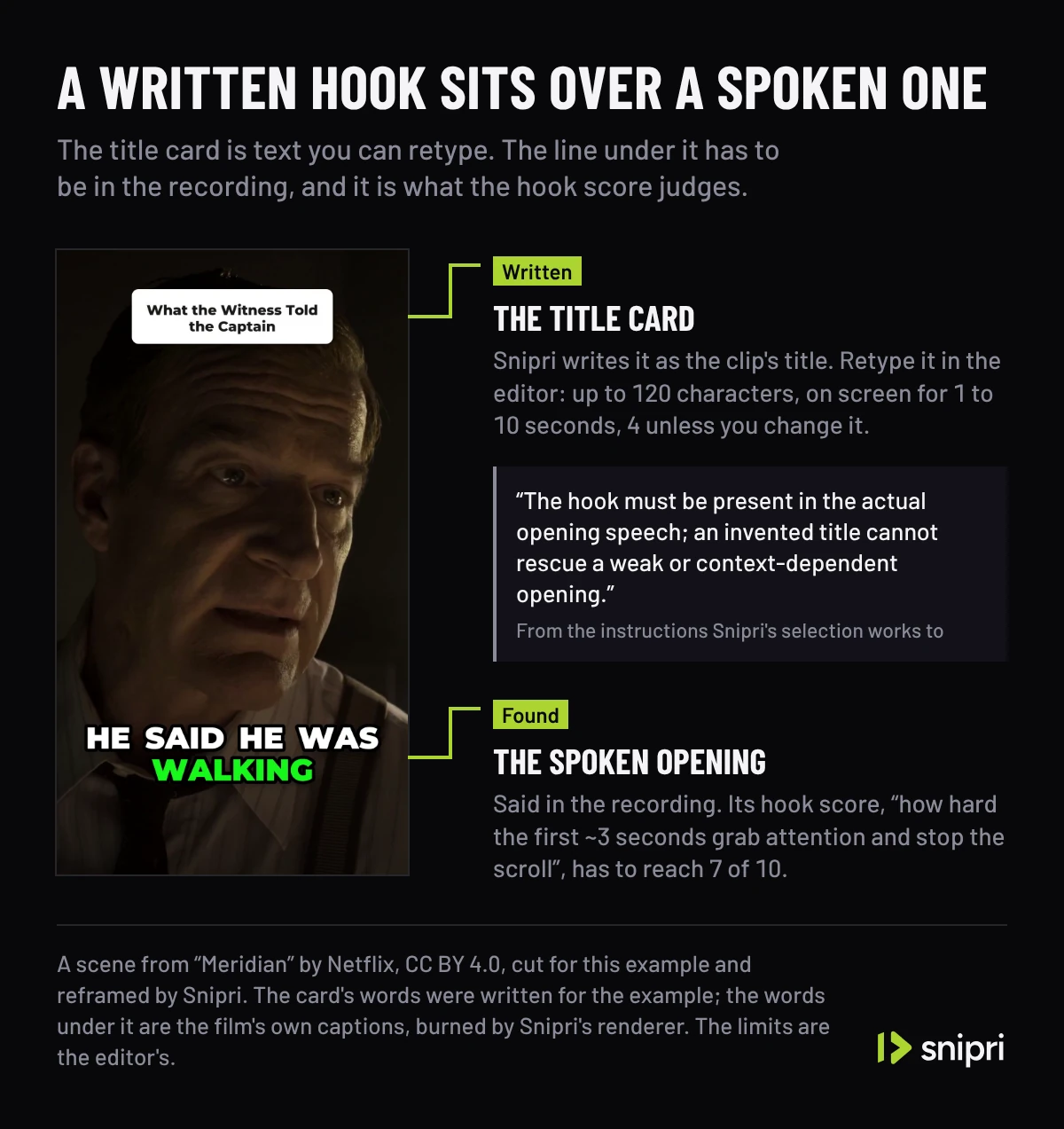
Edit the opening hook shows the card's settings.
How do you find the hooks in your own recording?
Listen for the kinds above at the start of a thought, then check that the line stands alone. By hand, that is three questions about each candidate:
- Would a stranger know what this is about? If the first sentence needs the one before it, start there instead.
- Is it one of the kinds? A question, a claim, a fact, a verdict, a problem or the first line of a story.
- Does the clip pay it off? An opening only works when the clip pays it off, so find the line that keeps the promise before you keep the opening.
In Snipri, upload the file, then pick the kind of video or leave it on Auto, so each opening is judged by its format's rubric. When you already know the question or the story you want, write it in Moments to look for: matching moments come first, and a request never turns a weak moment into a clip. Then open Why this clip on each result to read its hook score and the reason. See why a clip was chosen explains each score, and the podcast clip maker page shows a whole job on one of the talks above.
More guides on finding and cutting moments are under clipping.
Common questions
What is a hook in a video?
The opening of the video: what is said and shown in its first seconds, before a viewer decides to stay or scroll. TikTok's guide for small businesses says to hook viewers in the first three seconds, and YouTube's guide to Shorts says the first few seconds.
How long should a hook be?
Short enough to land in the window the platform names. TikTok's ad guidance says to put the hook in the first 6 seconds and what you offer in the first 3, and YouTube's page for long videos says the first 5 to 10 seconds. Snipri judges a clip's first 3 seconds or so.
Can I write a hook that nobody said in the recording?
Only as text. In Snipri the title card over a clip's first seconds is written, and you can retype it in the editor, but the spoken opening stays what it was. Snipri's selection is told that an invented title cannot rescue a weak opening, so pick a moment that opens well, or move where the clip starts.
Do hooks work the same on TikTok, Reels and Shorts?
The advice on each platform's own pages is close: TikTok says the first three seconds, YouTube's Shorts guide says the first few, and Instagram's Reels page says to surprise people with a reveal, a punchline or a twist. None of the pages read for this post promises views for doing it.
Why did a strong moment not become a clip?
Often because of how it opens. In five real jobs, 15 of the 20 moments that came closest fell short on the hook. When a job ends with no clips, Snipri lists those close calls with their scores and the gate each missed, and you can make one into a clip.
Sources
- TikTok Ads Manager: Creative best practices for performance ads, checked November 12, 2026.
- TikTok for Business: Video Advertising Guide for Small Businesses, checked November 12, 2026.
- YouTube Blog: Your guide to getting started with YouTube Shorts, checked November 12, 2026.
- YouTube for Creators: Long-form videos, checked November 12, 2026.
- YouTube Help: Search & discovery tips, checked November 12, 2026.
- Instagram for Creators: Reels, checked November 12, 2026.
Cihan DüzgörenBuilds and runs Snipri, and wrote this guide